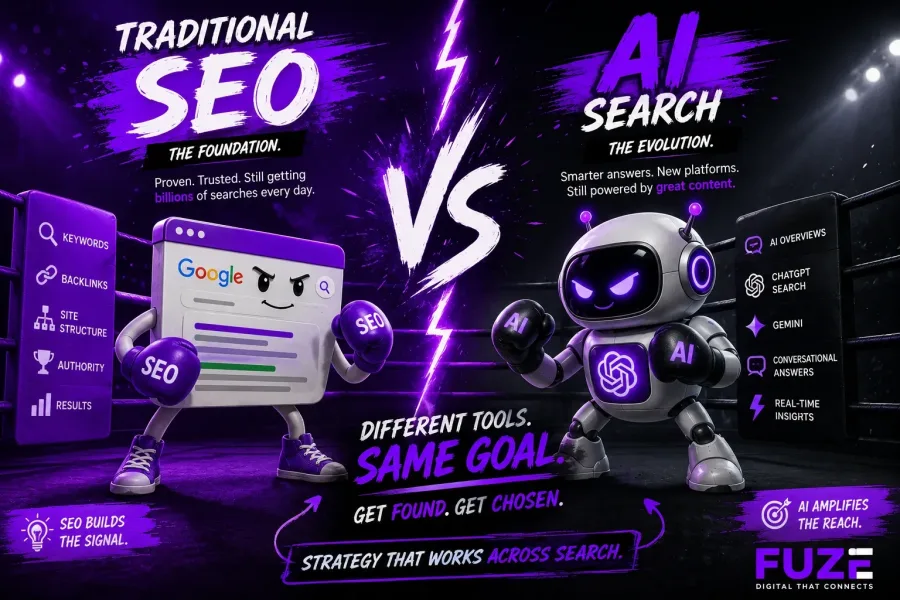
This doesn't mean ChatGPT has suddenly decided to become Google. ChatGPT Search has existed for some time. Instead, the designation is regulatory and reflects just how widely people are now using ChatGPT to find information online.
OpenAI reported approximately 159.1 million average monthly active recipients of ChatGPT Search in the EU during the six months ending March 2026. That's comfortably above the 45 million-user threshold used by the Digital Services Act.
For SEO, that's difficult to ignore. And yes that means EVERYONE with a website!
People are no longer discovering businesses exclusively through traditional search engines. They might Google "best accountant in Colchester", but they might equally ask ChatGPT to "recommend an accountant for a growing business in Colchester".
That means appearing within AI-generated answers is very much another part of search visibility.
But there is a big problem: tracking
This is where Google still has a significant advantage.
Through Google Search Console, businesses can measure impressions, clicks, click-through rate, average ranking position, individual search queries, landing pages, countries and devices.
Connect Search Console with GA4 and you can go even further, analysing what those organic visitors actually do once they reach your website, including landing-page engagement and key events.
ChatGPT doesn't currently provide website owners with an equivalent Search Console-style dataset.
OpenAI does make referral traffic easier to identify by automatically adding utm_source=chatgpt.com to referral URLs. So if somebody clicks through from ChatGPT, that traffic can be analysed in platforms such as Google Analytics.
The problem is everything that happens before the click.
You can't currently open an OpenAI dashboard and see that your business appeared 5,000 times, which prompts triggered those appearances, your average position within answers, how visibility changed month-on-month or how often somebody saw your brand but didn't visit your website.
And with AI, that last point matters.
Someone may ask ChatGPT for advice, read the answer, see your company mentioned and never need to click through at all.
That makes AI visibility significantly harder to quantify than traditional SEO.
Does this mean SEO is changing?
Absolutely.
But it doesn't mean traditional SEO is disappearing.
Google currently offers businesses a far more mature and measurable search ecosystem. ChatGPT represents an increasingly important additional discovery channel, but one where measurement is still playing catch-up.
The sensible approach isn't SEO or AI visibility.
It's making sure your business can be discovered wherever your customers choose to search.
And ChatGPT officially being classified as a search engine makes the argument that AI visibility has "nothing to do with SEO" increasingly difficult to defend.
If you want to make sure your business is visible across both traditional search and the growing world of AI search, speak to FUZE Agency about building an SEO strategy that covers both.